Temple Street Night Market Photography Guide
The short answer
Two frames carry this street. The archway at the Jordan Road junction, shot from the far pavement looking north into the market, and the Tin Hau Temple square at the other end, where the fortune-tellers sit under their own lamps. Everything else is detail between them.
The window that matters is short. Hong Kong's sky goes from sunset to the last of the usable blue light in 22 to 26 minutes: in 2026 the sun sets at 17:41 on 12 November and civil twilight ends at 18:04, while on 1 July it sets at 19:11 and civil twilight ends at 19:36. In that window the signs are already lit and the sky is still blue. After dark the market is lit by its own stalls, and you are shooting a different, harder picture.
Start at 1/125 s, f/2, ISO 3200, RAW, −0.7 EV and adjust from there. Ask before you photograph anyone. And arrive before 23:00, because that is when licensed hawker trading ends.
What the light actually is
There is no lighting scheme here to expose for. The market is lit by the stalls themselves. The Tourism Board describes the street "adorned with colourful signs and illuminated stalls", built on "contrasting light and shadows", and Wikipedia's entry for the street counts "more than a hundred stalls with colourful lights". Three things follow for a camera.
- The light comes from the side, not the top. Each pitch brings its own lamps, menu boards and signage, so the brightness changes from pitch to pitch and falls off toward the middle of the lane. Two frames taken two metres apart can want two different exposures.
- The brightest thing is not your subject. A lit menu board or a food lamp over a wok is several stops brighter than the person standing under it. Left alone, your meter protects the shadows and burns out the light, which is backwards.
- The colour is mixed, and nobody has measured it. Stall lamps, sign lighting and shopfront light are not the same colour, and no source publishes a figure for this street. Set one white balance and shoot RAW rather than letting auto white balance shift frame to frame.
Expose for the lit thing, not the lane. Put a spot meter, or your phone's tap point, on the lit stall front and let the lane go dark — it is dark. Expect to sit at −0.7 to −1.7 EV against what the camera proposes for the whole scene, and pull the shadows back afterwards. At dusk there is still enough sky light to hold both, which is the whole argument for arriving inside that window.
Two exceptions to the rule. The Tin Hau Temple interior is genuinely dim — the Tourism Board's own description is "flickering candles within the dimly lit interior" — and wants ISO 6400 and something to lean on, not a flash. And the dai pai dong tables sit further from the lamps than the pitches do, so a table of diners at dusk is the frame that works; the same table at 22:00 is a silhouette.
Where to stand
The archway at Jordan Road
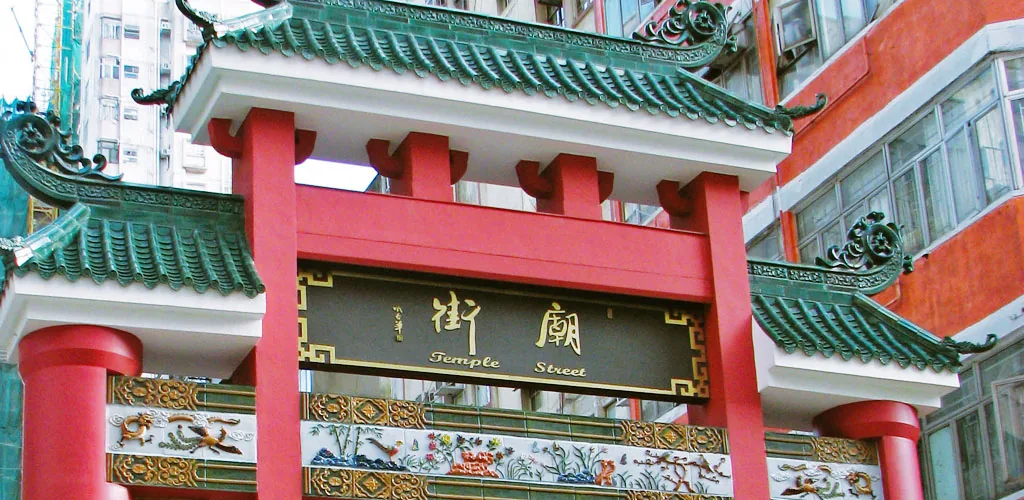
The gate at the Temple Street and Jordan Road junction is Hong Kong's first landmark archway: 10.5 m high, 8.9 m wide, unveiled on 18 December 2010 at a cost of HK$3 million. It carries a couplet on each face, which makes it two different photographs depending on which side of Jordan Road you are standing on.
Shoot it from the far pavement of Jordan Road, where the arch frames the lit market behind it — at dusk, with the sky still blue, is the shot. Then cross and shoot back south through it, for the couplet on the market face and the traffic beyond. From directly underneath you are photographing the underside of a gate; the distance shot is the one that shows what it is.
The Tin Hau Temple square and the fortune-teller row
The temple at 56–58 Temple Street replaced an earlier Tin Hau temple probably built in 1865; it was moved to its present site in 1876 and completed in 1878, and it is the largest surviving Tin Hau temple compound in Kowloon. Outside it, on the square, are the fortune-telling pitches — palm reading, face reading, bird reading — and Cantonese opera singers sometimes perform nearby.
This is the quieter half of the market for a camera, and the better half for people. The readers work at small tables under close lamps, so the light is on the subject rather than around them, which is rare on this street. Shoot the row wide from outside it, or ask before you photograph a consultation: the person in the chair is a paying customer, not a prop.
The street between them
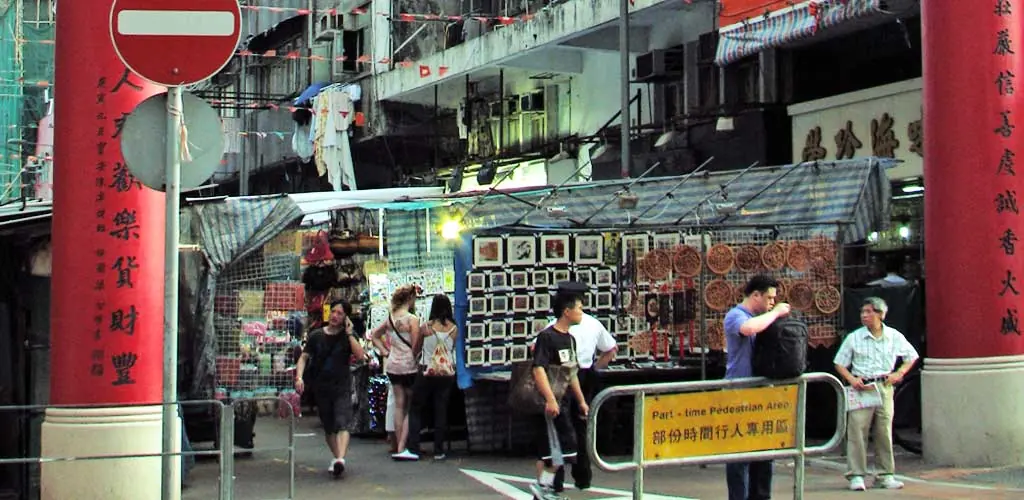
Do not expect one continuous corridor of stalls from the archway to the temple. The licensed hawker areas sit in two stretches — Kansu Street to Nanking Street at the Jordan end, and Man Ming Lane to Public Square Street at the temple end, about 600 licensed pitches between them — and the blocks in between are shopfronts, restaurants and dai pai dong tables on the pavement.
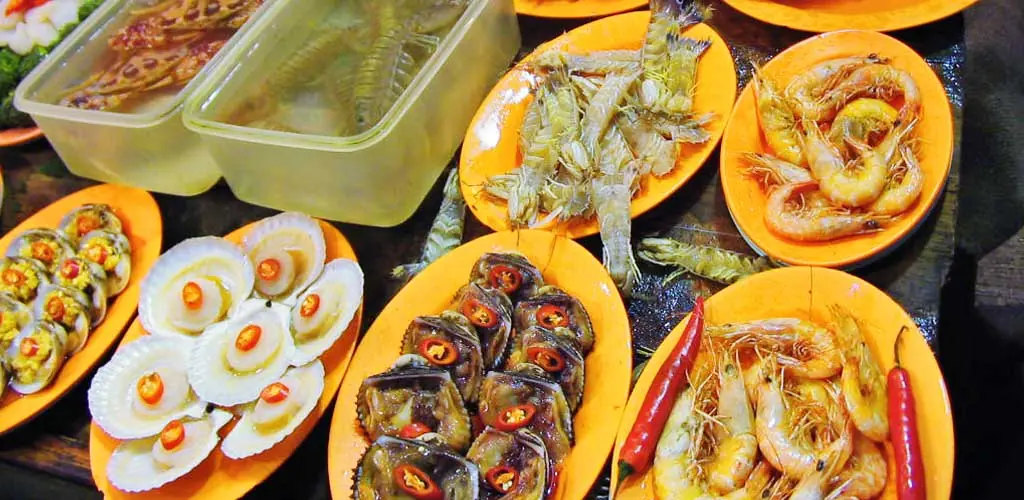
That gap is where the street's own signs live: restaurant fronts, seafood tanks, tables spilling off the pavement. It is also where you will think you have walked past the market. You have not. Keep going north.
Mido Cafe
Mido Cafe at 63 Temple Street has been a cha chaan teng since the 1950s and still has its stained glass, wooden booths and wall tiles; it has appeared in films. It is a working cafe, not a set: order something, and ask before you photograph the staff or the other tables.
Settings that work
| What you are shooting | Start at | Why |
|---|---|---|
| Walking the lane, people 3–5 m away | 1/125 s, f/2, ISO 3200 | Fast enough to hold walking pace; the ISO is what this light costs you |
| A vendor under their own lamp | 1/125 s, f/1.8–f/2.8, ISO 1600–3200 | Their lamp is the key light — open the aperture rather than slow the shutter |
| Food, steam, a wok | 1/250 s, f/2.8, ISO 3200–6400 | Freezes steam and hands; shoot slightly down onto the pan so the light rakes across it |
| Temple interior, candles | 1/60 s, f/1.4–f/2, ISO 6400 | Dim, and no flash — lean on a pillar or a wall |
| The archway at blue hour | 1/15 s, f/4, ISO 800, braced | Brace on a railing rather than carrying a tripod through the crowd |
| Vehicle light trails | 2–8 s, f/8, ISO 100, tripod | Not on Temple Street itself — see below |
On the light-trail shot. The Tourism Board suggests long exposures for "streaks of light from passing vehicles". On Temple Street itself that shot does not exist between 14:00 and midnight: the Transport Department has closed the street between Jordan Road and Kansu Street to vehicles in those hours, every day, since July 2002. Take the long exposure on Jordan Road or a cross street, from the pavement, and keep the tripod out of the road.
On a phone. Tap the lit stall front to focus and meter, then drag the exposure slider down until the lamp stops glowing white. Turn night mode off when there are people in the frame — it stacks frames and smears anyone walking. Use the main lens and walk closer instead of zooming; digital zoom on a night market is the fastest way to a soft picture. Lock focus and exposure before a burst so the phone stops hunting between frames.
On tripods. The lane is the pavement. It is narrow, people are eating at the edges of it, and a tripod across it blocks the market behind you. Shoot handheld, or brace on a railing, a bollard or a stall frame. If you want a tripod evening, take it to the archway and the Jordan Road pavement, or come at 17:00 while the stalls are still going up.
When to come, hour by hour
| Time | Light | What you get |
|---|---|---|
| 14:00–17:00 | Daylight | Stalls going up. The licence runs from 14:00 but the street does not: a 1999 government release recorded that in December 1998 only 11 per cent of licensees in the southern section were open by 15:00 |
| Sunset, then 22–26 minutes | Blue sky with the signs already lit | The window. The archway, the streetscape, the temple facade |
| 19:00–22:30 | Stall light only | The full market and its densest crowd — the crowd is what makes the picture and what makes it hard |
| 22:30–23:00 | Stall light, thinning | Shutters coming down and fewer people: the moody frame the Tourism Board recommends |
| After 23:00 | Street lighting | Licensed hawker trading has ended. This is a street again, not a market |
The clock moves by about 90 minutes across the year — sunset at 19:11 in early July against 17:41 in mid-November — so check the almanac for your own date rather than trusting a guide's word for "dusk". For the month-by-month picture, from rain to temperature, see the best time to visit.
Etiquette: who to ask, and who not to photograph
Nothing here is a set. The stalls are someone's income, the temple is a working place of worship, and the fortune-tellers are mid-conversation with a paying customer.
- Vendors: ask, and take no for an answer. A gesture at your camera and a raised eyebrow does the job; 可以影相嗎? ("may I take a photo?") is enough Cantonese for the rest. Some will refuse. A refusal is not rudeness, and shooting anyway is the one thing that turns a market against a photographer.
- Fortune-tellers: ask the reader and the sitter. A reading is a paid, personal conversation and the person in the chair is a stranger. Ask both, or shoot the row wide so that no face is recognisable.
- Opera singers: shoot from behind the audience. They are amateurs practising for themselves, not a show you bought a ticket to, and standing between singer and listeners changes the performance. No flash. More on Cantonese opera at Temple Street.
- The temple: no flash, and no faces without asking. Take the architecture and the candles from the edge of the space rather than the doorway, and step out of the way of anyone praying.
- The lane: take the frame and move. Stopping in the middle of it blocks everyone behind you. Step into the side of a stall, shoot, walk on.
- Buy something. It is the cheapest permission you will ever get, and the vendor who knows your face is the one who lets you stand there.
The wider etiquette — bargaining, cash, what not to touch — is on night market tips, and the one-page version of the whole visit is the first-time visitors guide.
Honest caveats
- There is no vantage point from above that we can send you to. The looking-down-the-street frames you have seen were shot from the Yau Ma Tei Car Park Building, the multi-storey car park at the north end. It closed for good on 1 January 2021 and the building has since been demolished for the Central Kowloon Bypass, so that height is gone. Plan a ground-level set. The arch gives you no height over the market at all, only the view of the street framed inside it.
- The vendor mix changes. A stall from a photograph may be gone, and no public source names individual pitches. The 2023 "Night Vibes" food street on the Jordan Road to Nanking Street stretch — around 22 food stalls plus about 10 snack stalls, trading 14:00 to 23:00 — was a time-limited pilot, not a permanent fixture. Do not build a shot list around it.
- Rain is unknown, not predictable. We found no operator statement on whether the stalls pack up in a rainstorm or a typhoon signal, so we will not guess at what the street looks like in bad weather. Check the Observatory's warnings before you cross town for the evening.
- Not all of it is lit for you. The blocks between the two licensed stretches are shopfronts and restaurants. They photograph as a street, not as a market.
- We found no published photography rule for the temple interior. Treat it as a place of worship: handheld, no flash, and ask if you are unsure.
An hour, in order
If you have one evening and one camera, this is the route. Be at the Jordan Road archway about 20 minutes before sunset and shoot it from the far pavement through the blue hour. Walk north through the Kansu Street–Nanking Street pitches while there is still light in the sky. Keep going through the restaurant blocks to the temple, and finish at the fortune-teller row and Mido Cafe, which hold their light until the shutters come down at 23:00.
Weeknights put fewer people in the lane than Friday and Saturday, which is the difference between a streetscape with room in it and a wall of backs. The market trades every evening; a weekday evening is simply the easier shoot.
Our own photo gallery is the argument for that timing: its 25 photographs were all taken between 17:39 and 18:23 on one October evening, before it got too dark to shoot.
More on the market
- The food guide and the fish balls guide — what is under the lamps
- Fortune telling at Temple Street — who is sitting at those tables
- Jade Market — the morning shot, a few minutes away
- Opening hours — the two clocks that run this street
