Jade Market Hong Kong at 251 Shanghai Street, Yau Ma Tei
Where it is: G/F, No. 251 Shanghai Street, Yau Ma Tei — the Yau Ma Tei Temporary Jade Hawker Bazaar, the market everyone calls the Jade Market. Hong Kong's jade hawkers were gathered into a market in 1984, and the bazaar moved to No. 251 in 2020 to clear its old Kansu Street corner for the Central Kowloon Route. The old corner has been empty since then.
That move is the first thing worth knowing, because most of what is written about this market still describes the site it left. Guides and listings print the Kansu Street and Battery Street corner, and some taxi instructions still give 261 as the street number — a number that appears on no record. Arrive at either and there is no market to walk into. The stalls are at 251.
The rest of this page follows the questions in the order they come up: when you can go, what is actually sold, what a piece costs and how you can check it, how to get there, and whether the trip is worth making next to Jade Street and the rest of Yau Ma Tei.
When you can go: nobody publishes the hours
Hours: nobody publishes them. The Food and Environmental Hygiene Department's record for this bazaar gives an address and nothing else, and the department's own data field for hawker-bazaar opening hours is empty for all ten hawker bazaars in Hong Kong — the same field is filled in for all 93 of its public markets. Go in the daytime, and treat any clock you see elsewhere as a guess.
That is the whole answer, and it is a more useful one than a number. A guide that prints a clock for this market is printing something no operator, no tourism board and no government department has published. Plan the bazaar as a daytime stop and keep the evening for Temple Street: the night market's trading window is a different subject with a posted answer, and what is posted for Temple Street is set out on its own page.
What you will actually find
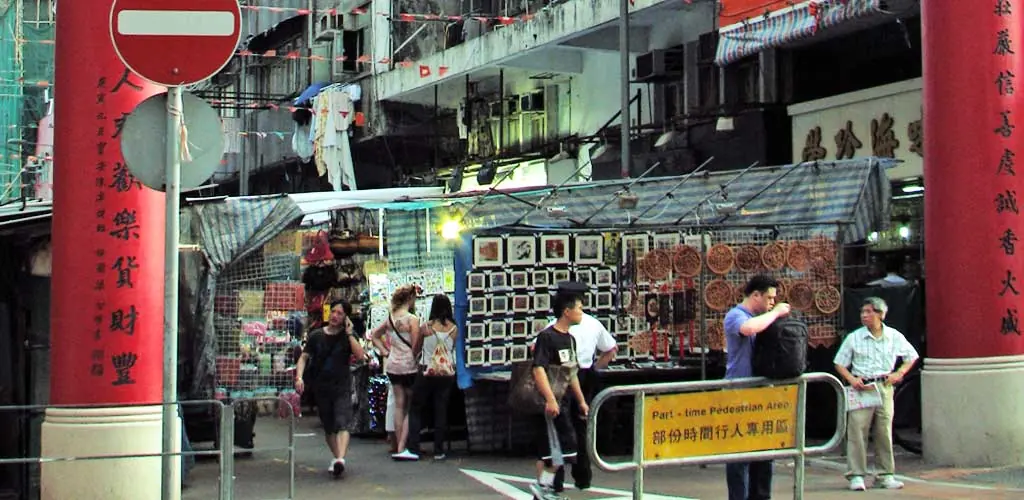
The Tourism Board calls it an indoor wholesale market: hundreds of small stalls selling jade trinkets, souvenirs, charms and jewellery, alongside pearls, turquoise, amethyst and amber, with ready-made earrings, bracelets, necklaces and rings on most tables. The permanent shops next door carry the expensive pieces — and will make jewellery to order.
The bazaar is licensed for 316 pitches, of which 33 stood vacant as at the end of 2022 — the most recent count the department has published. Take it as the size of the place rather than as this month's vacancy rate.
Look for the letter-writers. The Home Affairs Department records that the market "also gathers some letter-writers offering a wide range of services, including Chinese calligraphy, letter-writing in English and Chinese, and completion of application forms and tax returns", and calls them "among the few remaining operators of this ancient trade in Hong Kong".
What "real jade" means in Hong Kong law
What the stones are: Hong Kong law defines Fei Cui as a granular to fibrous polycrystalline aggregate composed solely or principally of jadeite, omphacite and kosmochlor, and accredited laboratories report it as one of four types — A (natural, untreated), B (chemically treated and resin-impregnated), C (dyed), or B+C (both). The standard behind those types is the "Standard Methods for Testing Fei Cui for Hong Kong" (HKSM/FCT-2016), written by the Gemmological Association of Hong Kong.
Two things follow for a buyer. The description is the part the law controls: "natural fei cui" and "natural fei cui plus other jade" are defined terms, and the receipt below is where you read them. And treatment cannot be settled at the stall — Type B and Type C name treatments, treatment is established by laboratory testing, and a certificate is the document that states which one applies.
What it costs
What it costs: there is no published price for jade, and no list to check. The Tourism Board's advice for Hong Kong street markets is that prices are often not displayed, that bargaining is possible where they are not, and that you should fix the price of the piece — and the unit it is being sold by — before you buy. In this market the only published figure is what a certificate costs (below), which is the one number that lets you judge whether a piece is worth testing.
Price bands for pendants, bangles and rings do circulate online. None of them is published by a shop, a trade body, the Consumer Council or a government department, so a budget built on one is built on someone's guess. The safe sequence is to decide what a piece is worth to you before you ask, and to walk away if the answer does not match.
The receipt the seller has to give you
What the law makes them give you: under the Trade Descriptions (Provision of Information on Natural Fei Cui) Order (Cap. 362M), anyone selling an article of natural Fei Cui at retail has to hand you an invoice or receipt that states the seller's full name and address, the price, the date of supply, and a description of the article as "natural fei cui" or "natural fei cui plus other jade" — and has to keep a copy for three years. The same law requires a notice at the point of sale explaining what "fei cui" and "natural fei cui" mean. A card from the stall is not a substitute for any of it, and a laboratory certificate does not replace the receipt either.
How to know the piece is real: the certificate
Who can actually tell you: Hong Kong's accredited laboratories test Fei Cui for the public, and the one the trade itself set up is the Hong Kong Jade & Stone Laboratory (HKJSL), founded in 1993 by the Hong Kong Jewellery & Jade Manufacturers Association and accredited under HOKLAS since 2004. It works by appointment only, and the laboratory's counter hours are Monday to Friday 9:00-17:30 and Saturday 9:00-13:00 (infrared testing only on Saturdays); tel (852) 2388 9688. The Hong Kong Accreditation Service lists six laboratories accredited for Fei Cui and/or diamond testing that serve the public, and notes that Chow Tai Fook's own testing centre does not test for the public.
What a certificate costs: HK$450 for a standard Fei Cui certificate on a piece worth HK$100,000 or less, or HK$250 for a mini certificate (members of the HKJJA, the association that set the laboratory up, pay HK$350 and HK$180). Above HK$100,000 the fee steps up in bands, and above HK$500,000 it is quoted. The certificate records the stone's shape, weight, dimensions, transparency and colour, the tests performed, and a conclusion on treatment — that is what you are buying: a description, from a laboratory, at a known price. No other number in this market is published.
| Fei Cui certificate | Association members | Non-members |
|---|---|---|
| Standard | HK$350 | HK$450 |
| Mini | HK$180 | HK$250 |
Prices for items valued at HK$100,000 or less, from the Hong Kong Jade & Stone Laboratory's published tariff (checked November 2026). Above HK$100,000 the fee steps up in bands; above HK$500,000 it is quoted.
The six laboratories that test for the public
- Hong Kong Jade & Stone Laboratory — 2388 9688, the trade's own laboratory (details above)
- Asian Gemmological Institute and Laboratory Ltd — 2723 0429
- CAC (Hong Kong) Gems Laboratory Ltd — 2153 3454
- China Gems Laboratory Ltd — 2783 2742
- Hong Kong Gemological Research and Authentication Centre Ltd — 2991 0383
- Hong Kong Gems Laboratory Co Ltd — 2815 1880
The six laboratories the Hong Kong Accreditation Service lists as accredited for Fei Cui and/or diamond testing and open to the public, with the telephone numbers it prints. Chow Tai Fook's in-house testing centre is on that leaflet only to record that it does not test for the public.
The trade bodies that exist, and the one that does not
The trade bodies that actually exist are the Gemmological Association of Hong Kong (GAHK, tel 2366 6006 — it publishes the Fei Cui testing standard), the Hong Kong Jewellery & Jade Manufacturers Association (HKJJA) and its laboratory, HKJSL. There is no "Jade and Gemstone Association of Hong Kong", so no stall can be a member of it. What you can check is the laboratory report on the piece, and the receipt the law requires.
Getting there
By MTR: Yau Ma Tei station, Exit C (Man Ming Lane) is the nearest exit — about 400 metres, five minutes or so: south along Nathan Road, right into Public Square Street, then left into Shanghai Street. No. 251 sits on Shanghai Street between Public Square Street and Kansu Street. Jordan station also works, but it is the longer walk — about 700 metres. No operator or transport authority publishes a walk time to this address, so both figures are our own estimate from OpenStreetMap foot routing.
To plan the walk, the Home Affairs Department's own instruction is to open the Transport Department's HKeMobility website or app and enter "Yau Ma Tei Temporary Jade Hawker Bazaar" or "Jade Street" as the destination.
By taxi: show the driver 油麻地臨時玉器小販市場,上海街251號 — or "Yau Ma Tei Temporary Jade Hawker Bazaar, 251 Shanghai Street". Ignore any listing that gives 261: the operator's address is 251.
Jade Street, Temple Street, and whether the trip is worth it
Jade Street: the stretch of Canton Road between Kansu Street and Jordan Road, a few minutes west of the bazaar, is commonly known as Jade Street. The shops there sell the high-quality end of the trade — and offer jade and gemstone identification. Treat the identification as a shop's opinion; the certificate that counts comes from an accredited laboratory.
Is the trip worth it? Yes, if you want to buy jade, to watch the letter-writers work, or to see a Hong Kong trade going about its business — and no, if what you want is an evening market with food and noise. The bazaar is a daytime stop; Temple Street is the evening one, and the two are close enough to pair on the same day. Around them, the district's own stops are set out in our sightseeing guide, and if jade is only one item on a wider shopping list, what to buy at Temple Street Night Market covers the stalls a few streets east.
