Temple Street Night Market First-Time Visitors Guide
The short answer
Temple Street Night Market trades every evening. The hawkers are licensed to sell from 14:00 to 23:00, and the street is closed to traffic from 14:00 to midnight. Come between 19:00 and 23:00, allow 1.5 to 2 hours, and budget about HK$80 to HK$200 a head if you are eating your way along it. Bring cash in small notes. Entry is free, there is nothing to book, and there is no evening of the week when it is shut.
When to come
Two different clocks run this street, and most guides confuse them. The first is the hawkers': the Food and Environmental Hygiene Department's fixed-pitch plan for the Temple Street hawker area licenses stalls from 2pm to 11pm. The second is the road's: the Transport Department's part-time pedestrian scheme has closed Temple Street, between Jordan Road and Kansu Street, to vehicles from 2pm to midnight, every day, since July 2002.
So midnight is not closing time — it is when cars are allowed back. And 2pm is not the time to arrive: the stalls are permitted from then, but the street fills after dark, and the 2026 guides that give a window put the liveliest stretch at 7pm to 11pm, with one saying 7pm to 10pm.
| Time | What is happening | Worth being there? |
|---|---|---|
| 14:00 | The street closes to traffic and licensed trading begins; most stalls are not yet set up | No — quiet, and most stalls are still setting up |
| 17:00–19:00 | The Arthur Street offal counter — one of the Michelin-listed shops — opens at 17:00, and food stalls set up through the early evening | Yes, if you want to eat early and walk |
| 19:00–23:00 | The full market: stalls, dai pai dong, fortune tellers, opera singing | Yes — this is the window |
| 23:00 | Licensed hawker trading ends | The market is winding down |
| Midnight | The street reopens to vehicles | No |
| After midnight | Last trains run just past 00:50 — see below | Only if you are heading for the MTR |
One measurement makes the point. In December 1998 the government counted only 11 per cent of licensees in the southern section open by 3pm, and about 30.7 per cent — roughly 110 hawkers — starting at 4pm. That is a 28-year-old figure for one section of the street, but it explains why "it opens at 2pm" is true as a licence and misleading as advice.
Which night. Weeknights are calmer, Friday and Saturday are the busiest, and one 2026 guide recommends 19:00 to 21:00 on a weeknight for a first visit. Which month. October to March is the comfortable stretch: the Observatory records that about 80 per cent of the year's rain falls between May and September, and calls November and December the best months of the year.
Getting there, and getting home
Two MTR stations bracket the market. Jordan (Tsuen Wan Line) serves the southern end, where the archway stands; Yau Ma Tei (Tsuen Wan and Kwun Tong Lines) serves the northern end, by Tin Hau Temple. MTR's own neighbourhood page signs Jordan Exit D as the route to Temple Street, a four-minute walk.
| Station | Exit | Best for | The catch |
|---|---|---|---|
| Jordan | D | The route MTR itself signs, four minutes on foot | — |
| Jordan | A | The southern archway end: turn right onto Jordan Road and walk to where it meets Temple Street; the market runs north from there | Stairs only (2022 government list) |
| Yau Ma Tei | C | The north end, coming up on Man Ming Lane and signposted for Temple Street, next to Tin Hau Temple | — |
Two exits that get recommended online do not serve the market and should be ignored: Yau Ma Tei Exit A2 puts you by Pitt Street and Kwong Wah Hospital, and Jordan Exit C1/C2 puts you on Austin Road or Bowring Street, by the Xiqu Centre. From Tsim Sha Tsui the whole trip is about ten minutes on foot or two minutes by MTR.
Getting home is the part people get wrong. "The MTR stops at midnight" is a rumour that costs you an hour of evening: last trains from Jordan are 00:52 towards Central and 01:01 towards Tsuen Wan, and from Yau Ma Tei 00:50 and 01:03. MTR's rule is that you may not pass the entry gates less than five minutes before the last departure, so treat 00:45 as your realistic cut-off. If you miss them, the overnight bus N122 runs between Shau Kei Wan and Mei Foo from 00:10 to 05:45 along Nathan Road, through both Yau Ma Tei and Jordan. For every other route, see how to get to Temple Street.
What you are actually walking into
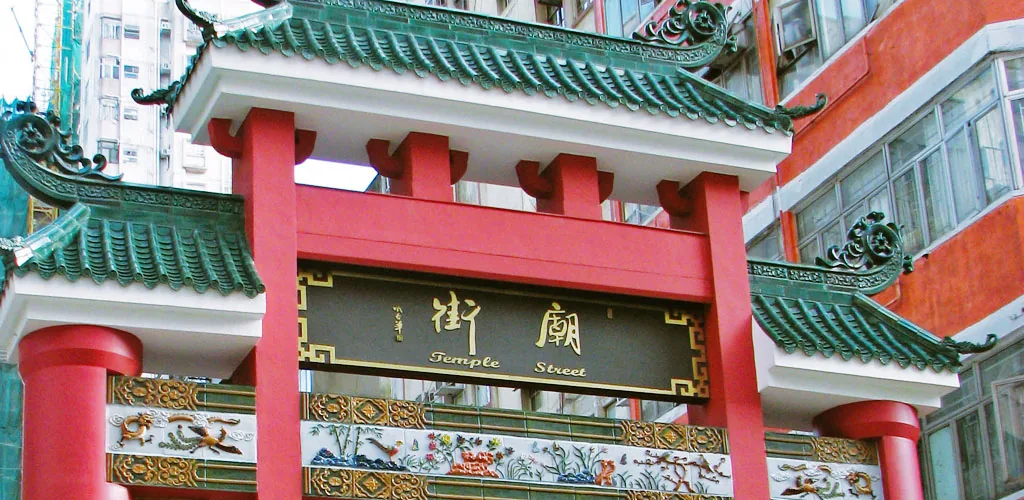
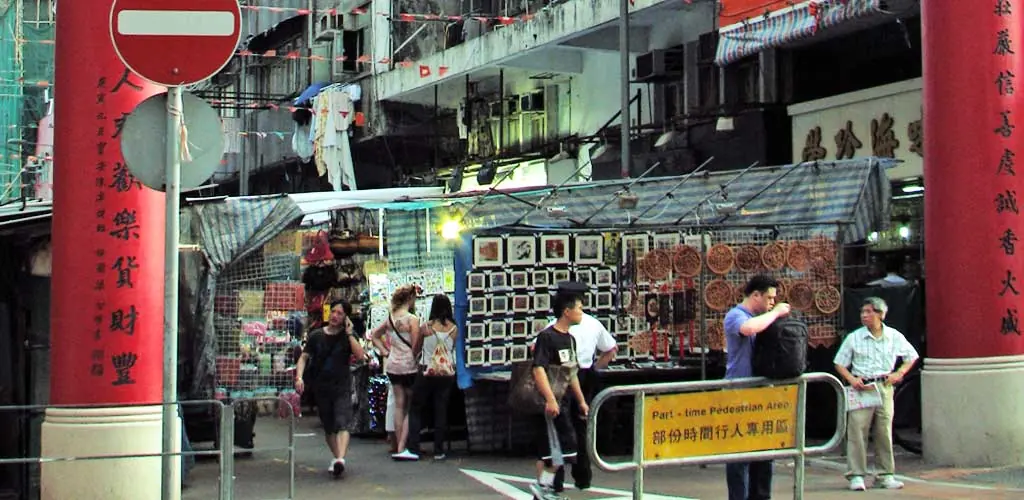
A working street that happens to be famous, not an attraction with a turnstile. The archway at the Jordan Road end is the landmark everyone photographs; north of it the market runs past stalls of clothing and accessories, dai pai dong tables on the pavement, and, around the Tin Hau Temple open square, the fortune tellers. The Tourism Board's own list of what makes the street is worth repeating: the temple — the largest complex dedicated to Tin Hau in Kowloon — Mido Cafe, the 1950s cha chaan teng, impromptu Cantonese opera performances, and roadside dai pai dong food.
Expect the whole of it to be busy from about seven, and expect the market to be a market: the noise, the crowd, and the occasional sudden burst of singing are the product, not an interruption to it.
Eating your way down it
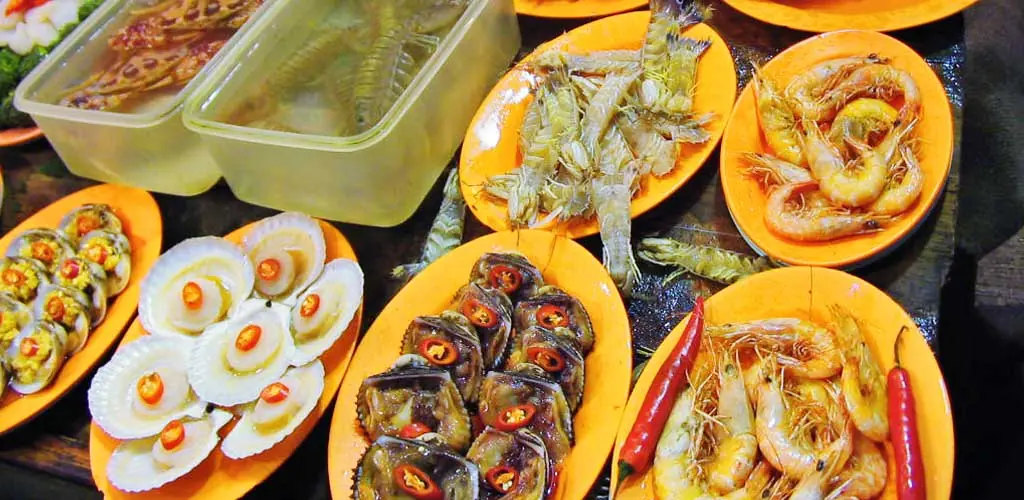
Most visitors eat standing or on a stool. Fish balls are the obvious first buy: about HK$15 to HK$25 a skewer, with the cheapest counters nearer HK$10. Claypot rice at the claypot house on the street is about HK$75 to HK$120 a pot; street-wide, pots run roughly HK$65 to HK$95. The 2026 guides put stinky tofu at about HK$20 to HK$35 and egg waffles at about HK$15 to HK$30.
Where to sit rather than walk: the claypot house and the dai pai dong tables, both of which want a proper appetite and twenty minutes. Where to walk: everything on a skewer. Two pages go deeper than this one can — the fish balls guide for the dish itself, and Michelin street food near Temple Street for the recognised cheap eats within a few minutes' walk of the market, none of which is a market stall.
Paying and bargaining
Cash is the default. Some stalls take Octopus or a mobile wallet; assume neither and you will never be caught out. Carry HK$20, HK$50 and HK$100 notes — HK$500 and HK$1,000 notes can be difficult to use for a small purchase. The Arthur Street beef-offal shop, one of the Michelin-listed venues on the street, is listed as cash only; so is Man Kee Cart Noodles, a Michelin-listed shop in Sham Shui Po.
Bargain on goods, not on food. Clothing, bags, accessories and souvenirs are all open to negotiation; cooked food, drinks and anything with a marked price are not. How far to open? The guides disagree enough to make a single number useless — they put the opening counter-offer anywhere from about a fifth to half off the asking price, which is too wide a spread to print as advice. The move that works is the polite one: open well below, stay friendly, and expect to meet somewhere in the middle. Walking away and coming back is part of the ritual.
A fortune reading is priced separately: typically HK$100 to HK$200 for a basic reading, with longer sessions running higher. Agree the price before the reading starts — that is the local convention and it removes the awkwardness at the end.
| Item | Typical price |
|---|---|
| Entry to the market | Free |
| Fish balls | HK$10–25 a skewer |
| Claypot rice at the Temple Street claypot house | About HK$75–120 a pot |
| Stinky tofu | HK$20–35 |
| Egg waffle | HK$15–30 |
| An evening of eating | About HK$80–200 a head |
| Fortune reading | Typically HK$100–200; longer sessions higher |
Type: indicative bands, checked 5 November 2026. Sources: Food and Environmental Hygiene Department and Transport Department (hours), Michelin and OpenRice (venues), 2026 market guides (dish bands). No official price list exists for the street.
What to buy, and what not to expect
The Tourism Board's framing is the honest one: inexpensive local souvenirs, clothing, accessories, jewellery, bags, vintage and second-hand items, and traditional arts and crafts. What it is not is an antiques market or a crafts fair — one 2026 guide puts it bluntly, that a visitor expecting "a genuine crafts market or a source of authentic local goods" will be disappointed. Go to browse, buy something small and cheap, and enjoy the theatre of it. The full catalogue is on what to buy at Temple Street.
Staying safe and not annoying anyone
The safety fact that is actually sourced is a traffic fact: the street is pedestrianised from 14:00 to midnight and busy throughout the licensed evening. Beyond that, ordinary crowd hygiene covers it — wallet in a front pocket, phone out of a back pocket, and a meeting point agreed before you separate.
The other thing worth knowing is a courtesy: the street is narrow and the foot traffic is constant, so stopping dead in a lane to take a photograph blocks the whole lane behind you. Step to the side, take the shot, move on. Our photography guide covers shooting the lane without blocking it. For a longer treatment, see the solo travel safety guide.
Where it fits in your trip
An evening block, not a day. The natural sequence is the Jade Market in the afternoon — it runs roughly 10am to late afternoon, so check before you build a day around it — then Tin Hau Temple in the late afternoon, then the market at dusk and dinner.
It pairs with Tsim Sha Tsui for the same reason: two minutes by MTR or ten minutes on foot.
Practical notes
- Free, and nothing to book. Temple Street is a public road with a pedestrian scheme — no ticket, no gate, no timed slot.
- No closing day: neither the hawker plan nor the pedestrian scheme publishes one.
- Prices are indicative: stalls are independent, so treat every figure here as a band, not a quote.
- The wider cost of the evening — taxi tariffs, what to carry, what the market's extras cost — is on Temple Street prices and fees.
- Checked 5 November 2026 against the government and MTR pages above; re-check the trains if you are reading this a year later.
Related reading: opening hours, what happens at closing time, the best time to visit and night market tips.
